The Closed Arc Guarantee: Why We Finished Writing The Moon's Curse Trilogy Before Publishing Book One
Every fantasy reader knows the quiet dread of reaching the last page of a great book, flipping to the author bio, and realizing Book Two has no release date. The narrative cuts out mid-flight, character arcs hang suspended, and the world goes cold for two, three, or four years.
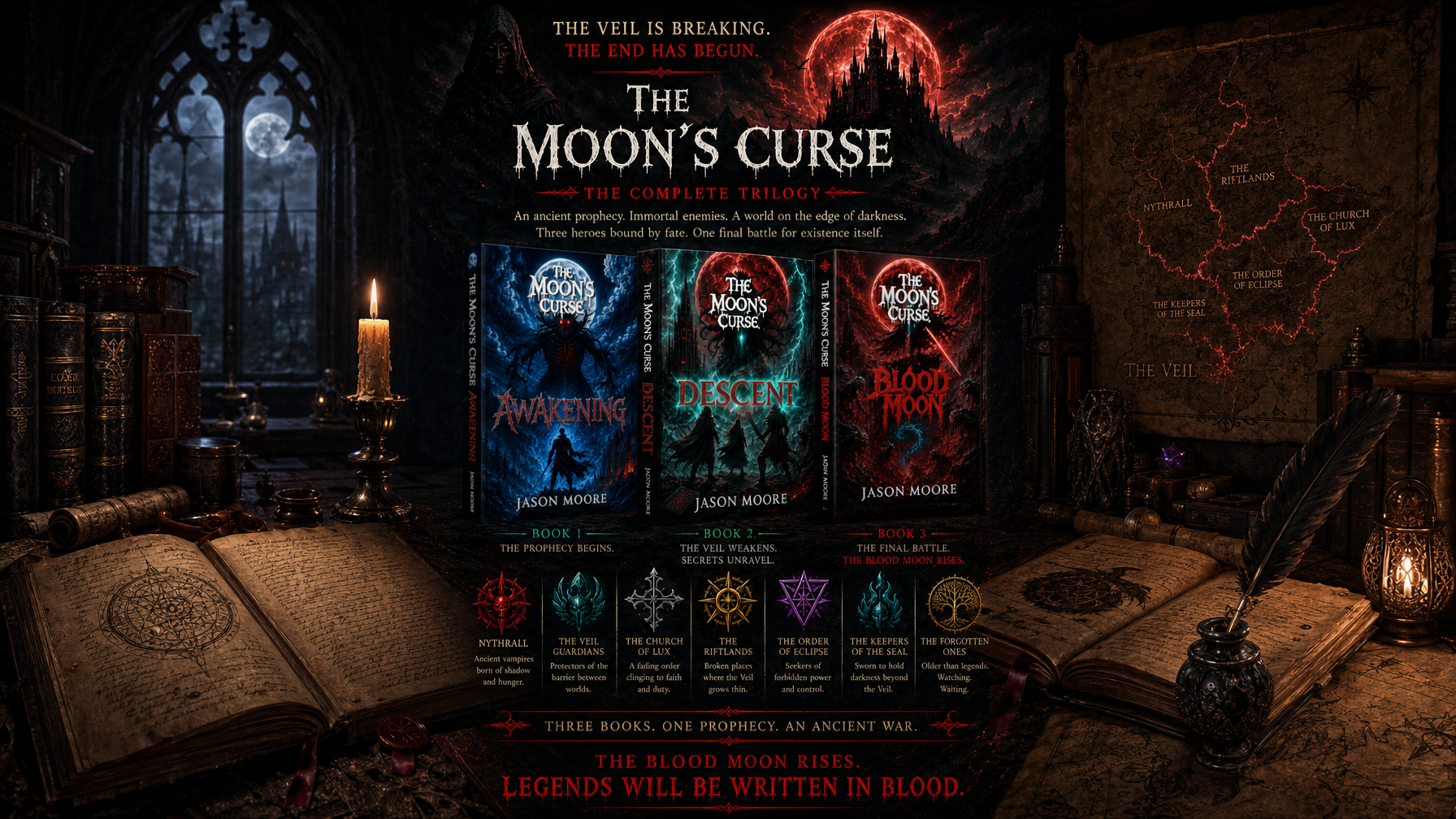
When we founded Londyn Publishing and set out to build The Moon’s Curse Trilogy, we decided to eliminate that waiting room. We wrote, structured, and completed the entire three-book arc, Awakening, Descent, and Blood Moon, before publishing a single page.
TL;DR
- The traditional serial release model leaves fantasy readers stranded mid-arc for years.
- Writing all three books of The Moon's Curse Trilogy before launch allowed us to embed exact foreshadowing and seamless character progression.
- Magic systems and covenant logic maintain total internal consistency without mid-series retcons.
- Independent publishing lets us offer readers a completed universe where the ending is already on the shelf.
The High Cost of the Serial Cliffhanger
In traditional publishing, releasing one book at a time while drafting the next is standard practice. But in complex, lore-heavy dark fantasy, that model creates hidden friction. Authors often discover late-stage plot holes in Book Three that require retroactively explaining away rules established in Book One.
Character motivations shift, covenant mechanics lose their sharpness, and readers are left holding partial promises. By the time the sequel arrives, the emotional momentum of the opening volume has evaporated.
Writing Backward from the Final Page
Completing The Moon’s Curse Trilogy as a single closed arc changed how we constructed the world. Because we knew precisely how the Blood Moon covenant ends and what cost Father Kalen's theology demands in Book Three, every detail in Awakening was planted with intent.
- Foreshadowing with Precision: Early references to the seventh unlocated Covenant Stone or Lira Thornfield's archive gaps are not vague world-building decorations. They are direct structural anchors tied to the climax.
- Organic Character Evolution: Evan Hartwell's transformation and Auren Draevan's field literacy develop across a single, continuous trajectory without mid-series reset buttons.
- Structural Integrity: The tension across all three volumes moves with steady pressure, building toward a final resolution that was locked in before manuscript one reached formatting.
Preserving System Integrity Across Three Books
Dark fantasy collapses when the rules of the world bend to solve a temporary plotting corner. The Veil in our universe is a living contract with rigid logic, and the Nythrall operate under explicit moon-bound laws.
When you write the entire arc before publishing, you never need to invent an emergency magic rule in Book Two to save a character. The constraints established in chapter one carry all the way through to the final line, giving readers a world that feels real, dangerous, and permanent.
Building Reader Trust as an Independent Imprint
For an indie imprint, reader trust is the most valuable currency. Releasing a completed series communicates that we respect the reader's time and investment. You can step beyond the Veil, immerse yourself in the lore, and read straight through to the ending without waiting on a publishing calendar.
If you are ready to explore a dark fantasy world built on closed-arc architecture, The Moon’s Curse Trilogy is complete and available in paperback, hardcover, and eBook on our store.


Comments
Post a Comment